This project seeks to better understand the observed variation in Global English vowels. The first step is to catalogue a broad range of English vowels and unify a description of each report (i.e., cast them within the same theory). Only then can we accurately talk about the entire language of “English” across locations. In parallel to gathering data, we need to answer a number of questions about vowels in general before we enter into a discussion of Global English vowel patterns.
An English variety can have between five and fifteen vowel qualities in their contrastive inventory of vowels. The standard American English vowel set of monophthongs used here employs a long/tense distinction [i e æ a ɒ ɔ o u] with a short/lax distinction [ɪ ɛ ʌ ʊ]. Beyond that contrast is a set of diphthongs, [aɪ aʊ ɔɪ]. This varies from Old English which had a single set of vowels which was parallel for long and short vowels: [iː yː eː øː æː uː oː ɑː] and the same set without the length diacritic. Received Pronunciation British English has a similar set without the front rounded vowels [iː yː eː øː æː uː oː ɑː] and short set, often written as [ɪ ɛ æ ʊ ɔ ʌ ɑ]. These varieties contrast with Kenyan and other East African varieties that have no long/short or tense/lax contrasts resulting in five vowels [i e u o a] and the three diphthongs. Other research use variation on vowel symbols and diacritics and may include in different sets, particularly for “r-less” variants resulting in [iː æ aː ɒ ʌ uː], [ɪ ɛ æ ɔ ʊ], and [eɪ əʊ aɪ aʊ ɔɪ] plus various diphthongs and triphthongs due to r-lessness. (Because these arise from the environment the vowel is in and can be reconstructed from those environmental triggers, we give less attention to them and more to the contrastive vowels).
Theoretically, we have a straightforward understanding of the variation ranging from OE to RP to AmE to a minimal Global Englishes found throughout the world (like in Kenya). The mechanism explained below combines Dimensional Phonology (Avery & Idsardi 2001) with the Successive Division Algorithm (Dresher 2009) in the spirit of phonological realism (Iverson & Salmons 1995). But, we’ll deal with all of this below.
It is important to clarify that vowel qualities are representative of how they are produced and how they are represented cognitively. We have three propensities that can lead us astray in our thinking about vowels from the very beginning.
First, we desire symmetry, balance and opposition. While we’ll see that vowel features (and all features for that matter) are oppositional because of commands to muscles, this desire for symmetry carries over to all vowels and their features (e.g., a vowel has to be marked for low and high, front and back, etc.). In the theory presented here, there are vowels–“default” vowels–that need no specifications but are critically unmarked with respect to all features (specifically, STRUT and GOAT in modern AmE).
Second, and relatedly, we desire a comprehensive and exhaustive system. Again, two vowels–one short and one long–will be relatively vague by being unmarked. STRUT is unmarked and is simply ‘not high’ (which doesn’t mean “low”) and ‘not front’ (which doesn’t mean “back”). We’ll see that the ‘not X’ is important because the sounds with this kind of marking will be free phonetically to range around the vowel space as long as that statement (and any others) are not violated.
Third, we desire to interpret cardinal vowel positions or symbols or auditory qualities as actual phonological statements. When something is half open, we treat this as lower mid and force the phonology to represent that even when there is no other mid vowel and that half open is just the mid vowel; conversely, that half mid vowel could be low if there is a contrastive high-mid vowel present.
Below, the vowels that we say we use are placed on a familiar vowel chart with a horizontal axis of front-central-back arrangement and a vertical axis arrangement of high-mid-low. It appears that the lax vowels are all in the high and mid arrangement and not low. It appears that the vowels are nicely arranged, even for the low vowels. Finally, it looks like the lax vowels are more centered and lower than their tense counterpart vowels. Whether or not that is true, those descriptions are not necessarily important to the phonology.
Figure 1. Traditional vowel chart with discrete boundaries for each based on vowel height, backness, and tensing.
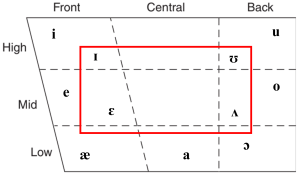
In short, we over-obligate the phonology with characteristics that do not deal with contrasts and lexical access.
If we confront our errors and try to to build a visual representation that boxes us in based on our propensities, we may need to come up with novel representations, one where vowels that are ‘not X’ can be represented just by not having an attribute. Specifically with respect to all Englishes, STRUT should be ‘not front’ and ‘not high’ while GOAT should be ‘not front,’ ‘not high,’ and ‘not low.’
The chart we will argue for herein is an attempt to capture the phonological categories of distinction (aka contrasts) and approximate acoustic positioning in the mouth. The chart on the left represents the cognitive arrangement of long vowels in American English; the chart on the right represents the short vowels.
Figure 2. English vowel chart with boundaries based on which active features are present for a vowel. Long vowels are in the top figure; short vowels in the bottom figure.
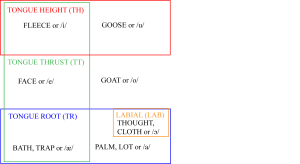
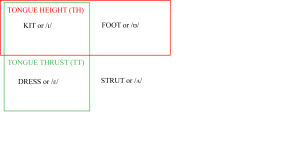
A few things to note about these vowel arrangements. First, we connect the capitalized word class names from Wells (1982) with the phonetic symbols. Second. we color-coded each singular box identifying the phonological dimension that connects the word classes/IPA symbols. Third, note the asymmetry in American English vowels where the low vowels have all collapsed into respective word classes of ambiguous length. We include these with the long vowels, as explained below. We’ll also see how an symmetrical Old English system (with a reflex in Mod British English) to the an asymmetrical one.
To demonstrate the difference between the traditional vowel chart for American English (Figure 1) with the dimensional chart (Figure 2), consider the “default vowels”, the word classes GOAT and STRUT. In the traditional vowel chart, the vowels are labeled by the quadrant they fill (“mid back vowels”). In contrast, using the new dimensional based chart, these two vowels are the unmarked vowels, that is, they are not high (TH) and not forward (TT). Moreover, the long GOAT vowel is neither low (TR) nor overtly round (LAB). Consequently, these vowels can appear phonetically in positions of the vowel space as long as they do not behave like they have one of the other specifications. It is very common to see the GOAT vowel in British English written as [əʊ]. This is not uncommon in American Englishes as well. In fact, we expect this type of production because the head of the /o/ vowel is not in the TT range, although it is fronted. Also, the tail of the vowel is not quite into the /u/ range (although the tail is less important than the head or overall arrangement of the head and tail). Thus, we have the following aphorism: Phonology sets the guardrails for phonetic implementation.
This explanation gets ahead of itself and it is important to read through the other pages to fill out the theory and understand the justifications for various position. Below are questions and answers about vowels in general, and specifically American English and Global English vowels. At present, the most coherent pieces outlining the view of vowels taken up here can be found in Purnell, Raimy, and Salmons, “Old English vowels: Diachrony, privativity, and phonological representations” (Language 95.4 (2019): e447-e473.) and Raimy, “Privativity and ternary phonological behavior.” (in Perspectives on Element Theory by Bendjaballah, Tifrit and Voeltzel (Eds.), pp. 65-110, Mouton). Three presentations represent our theory: Purnell’s virtual talk to an audience at the University of Victoria (February, 2022; slides here), another talk to IATEFL (April, 2026; slides here), and a talk by Purnell, Raimy, and Balogun at SHEL 2026 (May, 2026; slides here).
Because several people have proposed different ways of referring to different vowel symbols, we provide a correspondence table for vowel here.
This is an accordion element with a series of buttons that open and close related content panels.
What is a vowel?
A vowel may have independent definitions by domian: (1) phonology, that is, according to the abstract sound system; (2) articulation, that is, how a human language sound is produced via muscle enervation; and (3) acoustics, that is, by changes received by the hearing mechanisms arising from the movement of air molecules produced by the articulators. However, a vowel, by virtue of falling within the speech chain (Denison & Pinson 1993), also has a definition across levels simultaneously. A vowel cannot be defined by any one level alone.
Articulatory definition. Vowels
Putting this together. We should ask, what acoustic measurements arise from a specific articulatory gesture, and what articulatory gesture arises from phonological dimensions.
[first begin by connecting to Kingston & Diehl’s Language article, then Articulatory Phonology of Browman & Goldstein; Keating’s windowing ??]
What are the phonological characteristics of a vowel?
Phonological definition. A vowel is a discrete sound unit represented by (coindexed with) a timing unit equal to other timing elements (i.e., equal in this way with consonants). However, unlike consonants, a vowel is a set of phonological dimensions coindexed with a stress unit, a tone unit, and the nuclear sub-unit of a syllable. The evidence of this often comes from vowel deletion; when that happens, the features, stress, tone, and syllabification are also affected (also usually removed from the representation). We know that stress, tone, and syllabifiation are independent of the vowel because in some instances these are preserved in spite of the loss of the vowel (see instances of tone stability, stress shift, etc.).
Within the framework of Avery & Idsardi (2001), there are active phonological dimensions of a vowel, redundant dimensions, and inactive dimensions.
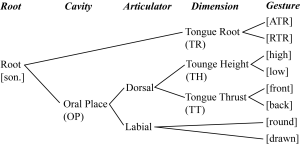
The predominate active dimensions of vowels include aspects representing (1) the concept of oral aperture to permit an open resonant tube (TONGUE ROOT, TONGUE HEIGHT), (2) the concept of attenuating that resonance from front to back (TONGUE THRUST), and (3) the concept of more fine-tuned resonant structure by extending the tube (LABIAL). Not all vowel systems make use of the latter two aspects; some systems may add other contrastive dimensions. Additional fine-tuning of contrasts can occur by changing the pharynx (XXXX). Moreover, although the laryngeal features are assigned by redundant rules for vowels, turning off the larynx by spreading the vocal cords (GLOTTAL WIDTH) or relaxing the vocal cords (GLOTTAL TENSION) is also possible (e.g., voiceless, creaky, or breathy vowels). Vowel contrasts may be further adjusted by nasalization (NASAL), lateralization (XXXX) or rhoticization (XXXX).
How is a vowel identified acoustically?
Acoustic definition. Vowels are resonants (see Chapter 10, Laver 1994), and thus display greater energy off of a null midline; the null midline represents air molecules at rest while the movement away from that represents greater or lesser air molecule movement. Air molecules move vigorously in a regular, sinusoidal pattern (consistently back and forth) when a vowel is produced.
Acoustic measure #1: Waveform. A waveform is a measure of air movement away (positively or negatively) from a state of rest (the midline) over time. Time is on the horizontal axis while the extent of movement (air pressure) is on the vertical axis. When a vowel is louder or softer, our human ear drum or diaphram on a microphone moves back and forth according to strength of the changes in air pressure.
A vowel presents a visual “fishbone” appearance on a waveform (a measurement of air molecule movement away from a state of no movement). Continuing the “fishbone” appearance of a vowel, we can describe five canonical (i.e., typical) aspects to the vowel energy envelope (i.e., outer pattern of energy contour) over time: there is often a rapid rise in energy at the vowel onset, a knee of leveling off, a peak, a knee following a slow decline, and a rapid drop. We relate these landmarks as co-varying with articulatory landmarks.
Acoustic measurement #2: Spectrogram.
Acoustic measurement #3: Spectral information.
Acoustic measurement #4: Intensity contour.
Acoustic measurement #5: Pitch contour.
How are vowels articulated?
Looking at vowel space plots over time, we see that vowels often have two points of slow velocity. The first of these slow points aligns with the head or nucleus of a vowel, while the second slow point aligns more closely with the tail of the vowel. From the view of articulation, the articulators move from the preceding segment towards a first target, then into a second target, and then towards the next segment.

A deeper comparison of the vowel space placement with articulator velocities bears out this two point patterns. [explain and use pictures from xray microbeam]
Another tool we can use is Paul Milenkovic’s VTSpec tool which models the vocal tract with X of slices. This model derives from work by Brad Story’s work.
[go through the vowels] Because we see vowels as competitors for lexical access, and we want to reduce the space of competitors for each vowel, we can use the VTSpec tool to ask, what do we do articulatorily to go from vowel A to vowel B and so forth. This allows us to look for natural articulatory boundaries on the vowel space.
This is an accordion element with a series of buttons that open and close related content panels.
Are all vowels competitors with each other and if not, why not?
When we list vowels as a set of objects (e.g., [i e o u a]) we seem to treat all the vowels as if they compete with each other. Perhaps this is how we approach vowels when we talk about minimal pairs and sets of words with minimal differences, such as Denes & Pinson’s The Speech Chain (their Table 2.1, p. 13; or any work where we find a list of words): beet, bit, bait, bet, bat, butt, boot, book, boat, bought, and bot. The assumption here is that the only phonological boundary is a minimal pair and the only phonetic boundary is the lips and throat.
But, at the both of the levels–phonological and phonetic–there are internal boundaries.
At the phonological level, not all vowels “compete” equally with each other. To begin with, to assume all vowels compete with each other is to assume phonological full specification and to ignore phonetic implementation, either from the articulatory landscape or notion that muscles come in pairs. Once you admit some kind of contrastive specification, that there are articulatory regions (e.g., Labial, Coronal, Back, Laryngeal), or pairs of musculature settings involving contraction, then you are also admitting that vowels have relationships with specific other vowels, not with all vowels. Moreover, within phonological theory is the notion of natural classes or groups of sounds which undergo similar processes for the same reason (e.g., non-low back vowels front). For all of these reasons, and a few more, the vowel space is not a wide open space where vowels can roam like cows in a single pen.
There is an internal structure to the relationship of vowels, and it is this internal structure that is at the core of our approach to vowels. In short, phonology imposes internal restrictions which phonetics cannot violate. If phonological was over specified, this structure would over constrain vowel expression; rather, we want a theory that has a minimal number of principled constraints which predict observed patterns of changes, shifts, and placement in the vowel space.
Not all vowels are competitors with each other. Why not? Lexical access (contrasts) and phonology rely on contrastive specification. We adopt the contrastive underspecification of Elan Dresher, Karen Rice, Peter Avery and others in what we call the Toronto School of Contrasts.
The foundation of contrastive underspecification is the Successive Division Algorithm, or a process children use to figure out which sounds are important and how to store that important distinction across the lexicon.
Successive Division Algorithm (SDA; Dresher et al 1994; Dresher 2009)
a. In the initial state, all tokens in inventory I are assumed to be variants of a single member. Set I = S, the set of all members.
b.
i) If S is found to have more than one member, proceed to (c).
ii) Otherwise, stop. If a member, M, has not been designated contrastive with respect to a dimension, G, then G is redundant for M.
c. Select a new n-ary feature, F, from the set of dimensions. F splits members of the input set, S, into n sets, F1 – Fn, depending on what value of F is true of each member of S.
d.
i) If all but one of F1 – Fn is empty, then loop back to (c).
ii) Otherwise, F is contrastive for all members of S.
e. For each set Fi, loop back to (b), replacing S by Fi.
Here’s how this works for our set of English short vowels, /ɪ ɛ ʊ ʌ/ (KIT, DRESS, FOOT, and STRUT).
- A child thinks all the vowels are the same.
- After noticing the long and short distinction, begins assigning the TONGUE HEIGHT to /ɪ ʊ/ as compared to /ɛ ʌ/ which are not.
- By noticing the difference between <beet> and <boot>, the child then breaks the high pair by TONGUE THRUST. The same happens for the low pair because of the difference between <bet> and <butt>.
The ensuing hierarchy for short vowels in English is: Tongue Height > Tongue Thrust. Thus, the dimensional specification for vowels is this.
- KIT: specified for TONGUE THRUST and TONGUE HEIGHT
- DRESS: specified for TONGUE THRUST
- FOOT: specified for TONGUE HEIGHT
- STRUT: not specified for either dimension
At the phonetic level, vowels can appear more fluid. Nevertheless there are considerations. For example, there are articulatory constraints such that high vowels lock the side of the tongue against the upper side teeth while the low vowel do the same to the teeth on the lower jaw (Steven 19XX: XX). This makes the low vowels more influenced by the jaw movement than the high and mid vowels.
Also, it is acknowledged by several researchers, that although practitioners place the THOUGHT and LOT vowels in different parts of the landscape, the only articulatory difference for many speakers lies in the lip gesture where the THOUGHT vowel has more lip rounding and protrusion than the LOT gesture. If this is true and the LOT vowel is a verifiable low tongue vowel, then so is THOUGHT. This can be verified by sensing that the side of the tongue locks down for THOUGHT on the lower teeth like other low vowels. You can also do a John Catford-like gestural experiment by starting with LOT and, keeping the tongue and jaw stable, round your lips to a THOUGHT vowel.
The final phonetic argument about vowel space inequivalencies (i.e., they are not all equal competitors) comes from our discussion of length (in another question). The upshot is that short and long vowels do not compete with each other. This means that part of the argument for the Southern Cities Chain Shift and even the rising peripheral/falling nonperipheral vowel issues need recasting. Stay tuned to other questions and answers for those.
What is more important for vowel space--height, backness, rounding, tenseness, or something else?
Aperture. That is, the amount of opening in the mouth distinguishes not only consonants from vowels, but within consonants and vowels, there is a distinction by oral opening or closure (aka aperture).
For consonants, we distinguish between obstruents (noticeable degree of closure from closed [plosives] to almost closed [fricatives]) and sonorants. Sonorants have some strange closure issues involving diverting air through the oral-pharyngeal port (aka nasals), blocking airflow centrally (aka laterals), blocking with one or multiple lingual bumps (aka rhotics), or leaving things pretty open (aka glides). In short, major consonantal sub-classes are identified by aperature.
For vowels, we distinguish between low, mid, and high vowels. There are other aspects, but when looking at minimal vowel systems there is a height contrast and front to back variation based on which consonants are adjacent. For us, an influential read on this is Ladefoged & Maddieson 1996: 286-292 (“Vowel height” and “Front-back variations in vowels”) because they distinguish the contrastive gestures (height) from variable gestures (backness) when languages have very minimal vowels.
We might wonder, then, whether phonology reflect this tendency. Asked another way, are Tongue Root and Tongue Height dimensions learned by children first rather than Tongue Thrust or Labial. At first blush, yes. Dresher et al. 1994, in their presentation of the Toronto School of Contrasts (see Avery & Rice 1991, Dyck 1992, Rice 1993, Rice & Avery 1991, 1993, Rose 1993, Walker 1993, Wu 1994) note that all other things being equal, argue for the following hierarchy of characteristics: Root > Air Flow > Sonority > Place (their (16), p. xii).
Is there a singular set of features behind all vowel systems?
It has been the assumption of modern phonology, at least going back to Jakobsen & Halle and Jakobsen, Fant, & Halle that all languages’ sound systems are grounded in a single uber-system of distinctive features and so forth. Each language makes use of a subset of those features. What the system looks like has been a central question in phonology.
We adopt the featural system modeled by Avery & Idsardi (2001) which has dimensions not distinctive features. As such, there is a level of representation that feels more like Particle Phonology because of the abstractness. The grounded feature of this theory is that lingustic gestures operate via muscles that are in oppositional pairs. For example, you can pucker or smile, but doing both seems out because resources you employ with your lips are going one way or the other; note that you can do neither.
They call the primary layer of organization for phonology the Dimensions. For vowels, these include TONGUE ROOT, TONGUE HEIGHT, TONGUE THRUST, and LABIAL. These dimensions are “completed”, that is, assigned a distinctive feature. The reason for separating these is that phonology should operate on dimensions because features can be assigned either by completion, and also by enhancement (like where phonation is assigned to sonorants and vowels as redundant features.
There are a set of vowel dimensions, but not all languages make use of them. Consider a language with five vowels like Spanish or Japanese. Given the SDA using Dimensions as storage units of contrast, we might imagine a hierarchy: TONGUE ROOT > TONGUE HEIGHT > TONGUE THRUST.
- /a/: TONGUE ROOT
- /i/: TONGUE HEIGHT + TONGUE THRUST
- /e/: TONGUE THRUST
- /u/: TONGUE HEIGHT
- /o/: Ø (we’ll return to what the “null” means)
The benefit of this system is that once the dimensions are set for the language, speakers have freedom to vary their sounds according to coarticulation, speed, or more important, according to their group behaviors.
What evidence is there that there is a singular phonological theory behind Global English vowels?
The short answer is that people have multiple grammars: a teaching grammar; a standard grammar; a local standard grammar; a local vernacular grammar, and so forth. A lot depends on how one’s home grammar relates to the first two (teaching, standard). Lavender (XXXX) argues for cascading abilities where those with command of the standard can have more vernacular, but those that only have the vernacular cannot have work back up; note the context for his claim is Singapore. Counter examples would be the many Standard American English speakers who have a vernacular that is almost identical to the SAE (stereotypical white Midwestern or Western college-educated folk).
There are three hypotheses (at least) when we consider grammars and in particular people with those. grammars communicating.
Hypothesis #1: there is no grammar for Englishes around the world and we’re just faking it. (null hypothesis)
Hypothesis #2: there is one and only one grammar for English and it is the same for all Inner Circle and Outer Circle environments; Expanding Circle environments are just being taught that one grammar.
Hypothesis #3: there are multiple grammars.
Hypothesis #3a: there are clusters of grammars, with two dominant historical grammars (Br Engl, Am Engl) from which all others are related.
Hypothesis #3b: there is a English standard grammar and local variants of that grammar which can have some different parameter settings.
We probably can toss the null hypothesis (#1) because we do comprehend each other in many ways. The issue is whether there is one singular grammar or multiple grammars that interact with “touchstone” standardized grammars.
We will see (a) similarity between Inner Circle grammars (or at least trace changes to similar underlying systems), and (c) how the Outer Circle vowel grammars result from contact-induced settings of Indigenous and colonial languages with factors of social class, education, history, etc. thrown in. Our first approximation is to go with some type of Hypothesis #3.
Note that it is possible for there to be communication between English speakers who do not strictly share the same grammar. For example, it is proposed that English is an aspirating language with a spread glottis gesture. However, in Nigerian English, the influence of voicing languages with an active slack gesture yields a “voicing” English. Nevertheless, both American English speakers and Nigerian English speakers can talk to each other.
The reason for this is that there is no conflict and the feature emphesized by one group can be an enhanced feature for the other. Specifically, the American English speakers will have long VOT values for aspirated plosives while Nigerian English speakers will have long pre-voiced (negative) VOT values for the “voiced” plosives. This subversiveness is echoed in how final devoicing emerged in the Upper Midwestern American English: immigrant groups brought devoicing but because American English has a /d/ along with the /t/, the /t/ can be a devoiced /d/–no problem. However, the same groups brought with them front rounded vowels which were not present in the founders’ English (some kind of Yankee English from western New England). The absence of the feature blocked the front rounded vowels. We’ll see how this blocking of potential imposition plays out if Global Englishes.
How does a hierarchy matter for vowel changes in a language?
Oxford 2018 and Purnell, Raimy and Salmons 2019 address the importance of the hierarchy for understanding language change. In this regard, the focus has been on Oxford’s Sisterhood Hypothesis. For Oxford, the Sisterhood Hypothesis says that mergers occur among sisters under the same branching node. In this sense, the AmE Low Back Merger of cot ~ caught, bot ~ bought, tot ~ taught, etc. where THOUGHT and LOT vowel classes merge because they are sisters in the hierarchy (this is covered at the end of this section).
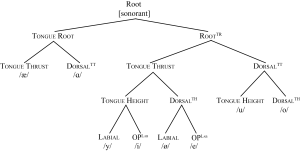
The history of English vowels provides several opportunities to observe mergers and changes within the English hierarchy: Tongue Root > Tongue Thrust > Tongue Height (> Labial). Old English had a parallel set of long and short monophthongs: [ɑ] in hamm ‘pasture’ and [ɑː] in hām ‘farmstead’ (Quirk & Wrenn 1957:12).
Here is the hierarchy and tree for Old English proposed by Purnell, Raimy & Salmons (2019). It applies to both long and short vowels.
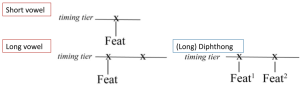
Before moving on, vowel length in Old English is structural, as depicted below. A short vowel is a single timing note affiliated (modeled by the line to “Feat”) with a set of features. A long vowel has two timing nodes (one preaffiliated) and long diphthongs which have two timing nodes and two affiliated feature sets. We’ll deal with the issue of OE short diphthongs elsewhere.
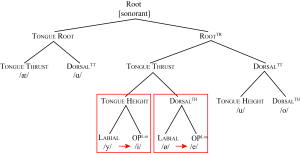
One striking difference between OE and modern varieties of English is the lack of front rounded vowels in the latter that were present in OE. In the tree below, the loss is seen as a merger of two sisters, affirming Oxford’s Sisterhood hypothesis. Labial had been actively distinguishing /y/ from /i/ and /ø/ from /e/, but when the Labial dimension was no longer distinctive, words with those front vowels were pronounced by the vowels with the superordinate OP-LABIAL.
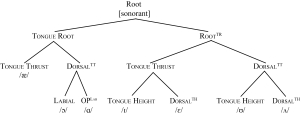
Another change between OE and modern forms was a split. Around the time of the Great Vowel Shift where high vowels were diphthongizing, the diphthong /au/ was monophthongizing to /a/. In order to accommodate /au/ > /a/, /a/ formed as /ɔ/. In terms of dimensional phonology, LABIAL was no longer being used contrastively after the loss among the high vowels. LABIAL thus was (and is) available to be employed under Tongue Root node, reflecting the fact that /ɔ/ is a pharyngeal (TR) and labial (LABIAL) vowel. This created the hierarchy tree as follows where Labial is again at the lowest point in the hierarchy, although it appears under the TR branch and not under the non-TR branch were it had been in OE. Importantly, this depiction is that of long vowels for both modern AmE and BrE, to which we now turn.
British English (BrE) is described as maintaining the long and short contrast among all the vowels, as in OE, including among the low vowels. The two groups of vowels are presented often using the following Wells (1982) word classes:
|
|
Non-low Vowels |
Low Vowels |
|||||
|
Short |
/ɪ/ |
/ɛ/ |
/ʊ/ |
/ʌ/ |
/æ/ |
/ɑ/ |
/ɔ/ |
|
|
KIT |
DRESS |
FOOT |
STRUT |
TRAP |
LOT |
CLOTH |
|
|
|
|
|
|
|
|
|
|
Long |
/iː/ |
/eː/ |
/uː/ |
/oː/ |
/æː/ |
/ɑː/ |
/ɔː/ |
|
|
FLEECE |
FACE |
GOOSE |
GOAT |
BATH |
PALM |
THOUGHT |
[talk about CLOTH merging with THOUGHT]
In AmE, the distinction between the long and short vowels in the low position (under TR) has disappeared through changes to the individual vowels, specifically with each short and long merging. What results is a vowel that can be of an ambiguous length. In fact, we argue that the phonetic implementation described in dialects reflects the ambiguity.
- Canadian and Californian and Elsewhere shifts may retract /æ/ towards /a/ without context
- Northern Cities, Southern Cities and prenasal tensing raise /æ/ towards /e/ contextually
- Low Back merger without context between THOUGHT and PALM; variability even among people with distinction in words with velar or velarized consonants such as <log> and <palm>, respectively.
To highlight the changes, the BrE tree below has boxes around each low vowel. These three mergers are important because the challenge the strict notion of Oxford’s sisterhood hypothesis. This first challenge comes from long and short vowels in exactly the same point in the hierarchy tree merging with each other. Identity of the dimensions, not sisters, is the critical piece here.
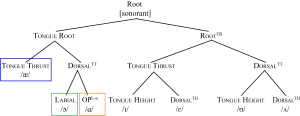
American English’s short vowel set is the result of two changes happened leaving the following reduced set of short vowels. These are not discussed in historical order. First, TRAP and BATH merged. Second, PALM and LOT merge. For some speakers of American English, this PALM/LOT merger also merged with THOUGHT (“Low Back Merger”). All of these merges have to do with a loss of the long short distinction among the low vowels, which explains why they are no longer in the hierarchy tree for low vowels in American English, as shown below.
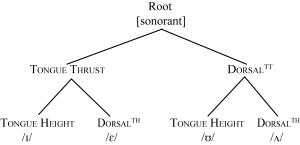
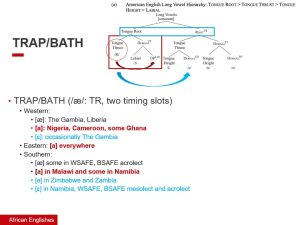
When considering the challenge of sisterhood as the lone means of merger, we come to the second challenge having to do with evaluation of sisters. These other changes are mergers which occur across the hierarchy tree when a singular, but higher, dimension is lost while preserving dependent distinctions. For example, in Zambia the English /æ/ rises to mid position. We account for this by the Sisterhood Hypothesis, although our evaluation of sisterhood has to be expanded to sisters at the level of dimension lost. The Zambian /æ/ (marked as TR + TT for English generally) loses TR but keeps TT; the sister of TR that has TT is /e/. Notice the change for /æ/ isn’t always /a/, nor is it the default vowel /o/. So Sisterhood has to be more generally about going from a specified dimension to its corresponding superordinate.
This shift is exemplified in the following slide from Purnell, Raimy & Balogun 2026.
Concluding this answer to the question, does the hierarchy matter, we turn to the basic set of English vowels that can be found globally: the 5 vowel system, exemplified by the Swahili-contact Kenyan English. Importantly, it is the “corner” low vowels which are lost, reflecting a continuation of the weakness of vowels in these positions. This yields a basic five-vowel system that closely resembles Bantu language systems with 5 vowels such as Swahili, another lingua franca in East and South Africa. This pattern is seen in many other varieties of Global English, particularly acrolectal contact situations.
Does a contrastive hierarchy exist for L2 learners of a language, particularly when learning a language late? Can people have multiple hierarchies?
Does a contrastive hierarchy exist for L2 learners of a language, particularly when learning a language late? Can people have multiple hierarchies?
[Things from Kwon and Starr & Kwon]
Do speakers of “grassroots” English (i.e., without formal training) have a hierarchy?
Do speakers of “grassroots” English (i.e., without formal training, usually only from contact such as informal travel settings, Schneider English Today 2016, Meierkord & Schneider 2021 World Englishes at the Grassroots, Edinburgh Press) have a hierarchy and access to distinctive features?
For such varieties where different Inner Circle varieties come in contact with a non-native speaker of English (i.e., if the input varies), what is the output and does that output vary across locations?
As to the hierarchy, one might suppose the Grassroots English speakers undergo the same, on-the-fly process as children. Or we might assume a more universalist hierarchy or a hierarchy mirroring the speaker’s mother tongue.
Note that examples of speakers of Grassroots Englishes are mirrors of middle-class SAE speakers who have 1 basic register. The point of Lavender’s cascading abilities may occur only when there are multiple inputs. Both the person who’s home language and school/work language is almost identical has the same issue, grammatically speaking, as the Grassroots English speaker: they have one grammar to use. Likewise, someone who learns English in an Expanding Circle classroom has one grammar. The real issue here is how these three types of speakers communicate. Most likely, they all converge in travel or Grassroots settings.
This is an accordion element with a series of buttons that open and close related content panels.
Why are long and short vowels designated as such?
Before there was discussion of tense and lax vowels in English ( or narrow/tense and wide/lax, Bell 1867), and before the Great Vowel Shift (XXXX), English vowels were divided into two sets: long and short. Short vowels were those that were checked while those which were long could be checked or open. Checking, in modern terms, is when a consonant occurs in the coda position of a syllable rime allowing only one vowel quality to occur before it. One facilitator of the Great Vowel Shift was that long vowels started diphthongizing such that the two timing slots of the long vowel began to have different articulatory positions (in theory this prevents diphthongization in short vowels because there is only one slot).
Consider the Middle English <ā> vowel. It came from the short vowel <a> which occurred in an open syllable in Old English (tale, bathe, shame, acorn, etc.; Kurath 1964: 102).
Which vowels go into which group may be a contentious issue and thus needs some background explanation.
Kurath (1964:18) and others note that length in (Inner Circle) English is not contrastive but depends on the following:
- Stress. Stressed vowels are longer in duration than unstressed or reduced vowels.
- Vowel height. Vowels made lower in the mouth (i.e., with more jaw opening or a lower tongue gesture) tend to be longer than vowels made with a higher articulation.
- Presence of coda consonants. Vowels that can be produced across the lexicon without a coda consonant (e.g., FLEECE, BOOT, FACE) tend to longer than those which are “checked” or have to be followed by a consonant in the same syllable (e.g., KIT, FOOT, DRESS).
- Phonation of coda consonants. Vowels followed by a phonated consonant in the same syllable tend to be longer than those which are followed by an unphonated consonant. Note that open or unchecked vowels are longer and may be grouped with those preceding phonated consonants.
Kurath (1964) and others divided the world of English monophthongs into two groups: checked vowels (i.e., those vowels only appearing with a final consonant, such as the KIT class; <bit> and <bid>, but not *<bɪ>); and, open vowels (i.e., those vowels which may be checked or open, such as the FLEECE class; <beat>, <bead>, as well as <bee>). You can see this by the examples on the vowel chart found here. Historically, many considered this difference to be reflected by the long~short or tense~lax distinction where the short/lax vowels were checked or closed.
Thomas (2011) also provides a related list, this time on tense and untensed vowels. He enumerates the following for Germanic language family (of which English is a member).
- Length. Tense vowels tend to be longer than lax ones. (Peterson & Lehiste 1960). (The covariance of length and tenseness doesn’t help distinguish between the acoustic features, but one could use either or both as a cue to the vowel group)
- Peripherality in the vowel space. Tense vowels are more peripheral than lax ones. (Lindau 1978; see also Labov 1994:XX)
- Phonatory accompaniments. Tense vowels tend to be breathier and lax vowels tend to be creakier. (although this may be a function of closed and open; see discussions of tonogenesis in Southeast Asian languages, e.g., Benedict XXXX, Haudricourt XXXX)
- Spectral movement. Tense vowels tend to be more diphthongal than lax ones (though Thomas lists some exceptions).
However, there are some issues with this distinction. Importantly, the closed~open, tense~lax, long~short distinction works well for the high vowels (FLEECE~KIT, BOOT~FOOT) and even the front mid vowel pair (FACE, DRESS). Importantly, there is no tense~lax contrast (note the use of this critical term and word) among low vowels (we’ll come back to GOAT and STRUT later). This is a non-trivial point because it means that low vowels can be more flexible with their identity (particularly their duration, peripherality, and diphthongization) because that aspect of phonology is not present.
The question is, then, why do we put all the low vowels–which we consider here for Modern American English to be /æ a ɑ ɔ/–with long vowels and not short. The reason is in how they pattern with respect to length and spectral movement. Consider the picture below of vowels measuring vowel heads and tails (nuclei and off-glides?; explanation here).
For each vowel, this graph plots the time between the head and the tail against the spectral movement of the head to the tail (Euclidean distance). Our expectation is that there could be four groups: short and long monophthongs with little spectral movement over time; and short and long diphthongs with greater spectral movement over time.
We observe the data and posit three groups.
Why are long and short vowels designated as such? Is the basis based on distinctive features, phonetic patterns, or natural classes as revealed in phonological processing?
Why is /ʌ/ a short vowel and not a long one?
Why is /ɔ/ a long vowel and not a short one?
Is /æ/ a long or short vowel?
Are the tense-lax vowels actually changing place for high and mid front vowels in the SCCS or is this an illusion of sorts? What role of sentence-level confusion does this cause? Do people without the shift get confused when talking to people with the shift?
If there are two separate sets of vowels based on one or two timing slots, what do we do with the Southern Cities Chain shift where the front tense-lax vowels “changing place” in the vowel space. Or is this an illusion of sorts? [I’ll argue for an illusion]
What role of sentence-level confusion does this cause? [good question, but I suspect not much]
Do people without the shift get confused when talking to people with the shift? [again, as someone married to a Southerner and having had conversations with Southerners, I haven’t noticed too much confusion–but I could be talking to the wrong Southerners]
Why do many languages lose the long-short/tense-lax distinction first?
It is the case, from geography to geography, speakers of Englishes outside the Inner Circle, may lose the long-short/tense-lax distinction. For African English varieties influenced by Bantu languages, specifically the Bantu lingua franca Swahili, the English vowel inventory is greatly influenced by the five vowel system (/i u e o a/) of many Bantu languages. Thus, we can say that the tense~lax/long~short system is straightforwardly influenced this way. Additionally there is the issue of the low vowels, but we’ll save that for later. These changes for the high and mid vowels affects Southern African Englishes in Malawi, Zimbabwe, and Zambia, and for Eastern African Englishes in Kenya, Uganda, and Tanzania. The situation in Western African Englishs and in South Africa are complex. While Nigerian English loses the distinction, the distinction is not necessarily lost in Cameroon, Liberia, Ghana, and The Gambia. Some of the preservation may come from pressure by increased historical contact with American English (Liberia) and French (Cameroon).
But note that even in other high Am Engl contact settings, such as with basilectal, mesolectal, and acrilectal Filipino English (X, XXXX), we see that the tense/lax distinction is also lost first.
The claim most people make about this is that the Indigenous languages do not have a long-short or tense-lax distinction. However, some do and they lose that distinction anyway. For example, Hausa speakers do this; perhaps there is influence from Yoruba and other languages influencing Nigerian English and the Hausa speakers just go along. Given that Nigerians can tell what a speaker’s source language is, this hypothesis may be a bit weak.
Why do some varieties lose long-short distinctions for monophthongs, but not lose their (3 main) diphthongs?
To ask the question (and it is a legit question) about why some varieties would lose the long-short monophthongal distinctions but not lose their (3 main) diphthongs may be additional evidence that the field (mistakenly) treats all vowels (including the mono- and di- distinction) equally. Perhaps we view vowels along a cline of spectral movement between their heads and tails from none (/I E/) to some (/e o æ/) to lots (/aj aw cj/). Contact alone also does not make the right predictions (see Eastern African Englishes below).
However, with a three way distinction of timing slots and having features or not on the second timing slot, we now have a structural (or discriptively structural) difference. Changes can happen, then, to just one of those groups thereby neutralizing the long-short monophthongal distinction while preserving the diphthongs.
It is important to remember that vowel movement is an inherent feature of vowel systems if there is some independence of the two timing slots.
Now let’s look at the distribution pattern in African Englishes. From the data below, outside from Liberian CHOICE, Western and Eastern African Englishes retain the diphthongs. Also, in South Africa varities and Namibia, the diphthongs are largely present. The place where diphthongs are monophthongized are in Malawi, Zimbabwe, and Zambia (Southern African English varieties highlighted below). In a sense, most of the retention seems unexpected outside of South Africa. In Eastern African Englishes, we expect monophthongization like with the three Southern African English locations, but these Eastern varieties retain the diphthongs.
PRICE (/ai/: TR + TT, TH, two timing slots)
- Western: [ai] everywhere
- Eastern: [ai] everywhere
- Southern:
-
- [ai] in Namibia, some in WSAFE
- [a] Malawi, Zimbabwe, Zambia, and some in WSAFE
- [äɪ] some in WSAFE
- [ʌ] or [ʌɪ] in BSAFE acrolect; [ʌɪ] in BSAFE mesolect
MOUTH (/au/: TR + TH, two timing slots)
- Western: [au] everywhere
- Eastern: [au] everywhere
- Southern:
-
- [au] or [aʊ] in Namibia
- [a] or [o] in Malawi, Zimbabwe, Zambia
- [äʊ, aː, æʊ] in WSAFE
- [o] or [ɔʊ] in BSAFE mesolect
- [aʊ] or [ɔ] in BSAFE acrolect
CHOICE (/oi/: NULL + TT, TH, two timing slots)
- Western:
- [oi]: almost everywhere
- [ʌ]: Liberia
- Eastern: [ɔi] or [oi] everywhere
- Southern:
- [oi] and [ɔi] in Namibia
- [o] Malawi, Zimbabwe, Zambia
- [ɔɪ] in all SAFE varieties
What do we make of systems where the high vowel long-short distinction is lost but not the mid front long-short distinction?
What do we make of systems where the high vowel long-short distinction is lost but not the mid front long-short distinction?
Why do some varieties not have a long-short distinction even when a local contact L1 language (Hausa) have an analogous distinction?
Why do some varieties not have a long-short distinction even when a local contact L1 language (Hausa) have an analogous distinction?
This is an accordion element with a series of buttons that open and close related content panels.
What is the featural relationship between high and mid vowels in English?
[discuss high and mid articulation description in Stevens, perkell, etc.]
Is Advanced Tongue Root is a dimension for English high and mid vowels? How would this jive with languages such as West African ones which are traditionally described as having an ATR setting? Is there evidence from their English of the use of ATR?
Is Advanced Tongue Root is a dimension for English high and mid vowels?
How would this jive with languages such as West African ones which are traditionally described as having an ATR setting?
Is there evidence from their English of the use of ATR?
What do we make of systems where the high vowel long-short distinction is lost but not the mid front long-short distinction?
In Western African Englishes, Nigerian English speakers collapse the long-short/tense-lax distinction so that /i u e/ and /ɪ ʊ ɛ/ all are pronounced /i u e/, respectively (ref). In Liberia and Ghana, the distinction for English speakers is observed as preserved (ref), in part because of contact with American English. In Cameroon, the high vowel long-short distinction is neutralized, but not the mid front long-short distinction (ref).
A preservation may reflect the presence of an ATR system in the Indigenous languages, although just having speakers with familiarity with an ATR vowel system or even a long and short system does not predict transfer of that concept. Hausa, for one, has long and short vowels, but Nigerian English in Hausa areas does not retain that feature (ref). Cameroonian languages such as Yemba, Ewondo, and Duala have the ATR contrast, while Basaa has ATR and length; the language with the most number of speakers, Fulfulde, has length, but no ATR distinction. Additionally, the preservation of mid vowels in Cameroon French along with the presence of rounded versions of the front vowels may not be as strong an argument as the presence of the Indigenous language ATR systems.
Wikipedia lists 9 Indigenous (regional) languages of Nigeria. Those with neither length nor ATR distinction are: Nupe; Kanuri, Ibidio. The languages with both ATR and a long~short distinction is represented by Tiv. Hausa, as mentioned is a language with length and not ATR. Those with ATR but not length include Yoruba, Efik, and Edo.
Contrasting the Indigenous language variation in both Nigeria and Cameroon suggests that while local languages might be a factor in English vowel variation, so could colonial language (and education and identity).
Is the phonetic difference between RP BrE GOAT /əʊ/ and Std AmE GOAT /o/ important?
The importance of a reported phonetic difference between the fronted RP BrE GOAT /əʊ/ and central back Std AmE GOAT /o/?
For many Am Engl speakers, /o/ shows up phonetically where one expects as [ou]. Yet as it turns out, a number of American English varieties have fronting of the head of the vowel. Moreover, there are other types of variants among the US English varieties beyond just fronting of the nucleus. The following picture depicts movement of the GOAT vowel, and we should expect as much movement from other varieties of English for the GOAT (or /o/) vowel.
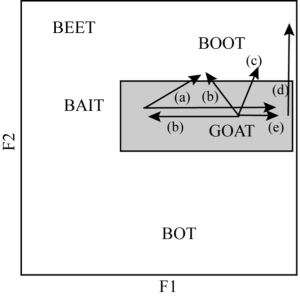
One consequence of having such variation is that the surface form of GOAT involves a nucleus that occurs in a central to back position and an offglide (or tail) that ranges from nonexistant to flat to a raised position, higher in the vowel space.
Thus, the RP version, like all other variants of GOAT, is just an /o/ phonologically.
Why aren’t RP BrE FACE and GOAT included with monophthongs?
In various descriptions of RP and variants of British English, the FACE and GOAT vowels are not included with monophthongs. When this occurs, it often is because they are included with diphthongs based on their surface behavior. It isn’t clear what the phonological evidence is of this practice.
Why is the front high vowel (FLEECE/KIT) more consistent in its location than the high back vowel (GOOSE/FOOT)?
Conceptually, the /e o/ (FACE, GOAT) pair of vowels constitutes a "front-back" pair. Are they articulatorily a pair? Phonologically are they a pair?
In short, yes, they are phonologically a pair and can be considered part of the long vowel set with simple vowel qualities /e/ and /o/, respectively. They do have different places on the phonological hierarchy with a consequence of this difference on the articulatory landscape.
In the vowel hierarchy for English, /e/ is marked actively with TONGUE THRUST and crucially marked with the superordinates ROOT-TH and TR. /o/ has no active dimensions as the unmarked long vowel. Because of the difference of TT, /e/ does not centralize in the same way as the unmarked /o/ does. This is a phonologically-driven difference.
This is an accordion element with a series of buttons that open and close related content panels.
How can low back merger speakers live in the same spaces as speakers who don’t merge the low back vowels?
Low back merger speakers indeed live in the same spaces as speakers who don’t merge the low back vowels. Anecdotally, merged (e.g., Prof. Raimy) and unmerged (e.g., Prof. Purnell) can communicate successfully with each other.
In a paper analyzing field notes and recordings in the Upper Midwest, Purnell, Raimy, and Salmons (201X) found that merged and unmerged occupied similar space in the Upper Midwest.
Why do BrE-contact varieties (most western, eastern, and southern African) merge /æ/ with /a/, while AmE-contact varieties (Liberia, Philippines, Brunei) merge /æ/ with /ɛ, e/?
Why do BrE-contact varieties (most western, eastern, and southern African) merge /æ/ with /a/, while AmE-contact varieties (Liberia, Philippines, Brunei) merge /æ/ with /ɛ, e/?
Are /æ/ and /ɔ/ rare in languages?
Are /æ/ and /ɔ/ rare in languages?
Why do TRAP and BATH vowels merge into /æ/? Why were they not merged?
Why do TRAP and BATH vowels merge into /æ/?
Why were they not merged?
What do we make of some dialects appearing to have a long (rising, breaking, diphthongizing) /æ/ while others appear to have a short (low-front, backing) /æ/? Do we need an English grammar with two /æ, æː/, or is it better to have them related by synchronic or diachronic rules? What about communication between native varieties with the two different /æ/?
What do we make of some dialects appearing to have a long (rising, breaking, diphthongizing) /æ/ while others appear to have a short (low-front, backing) /æ/?
Do we need an English grammar with two /æ, æː/, or is it better to have them related by synchronic or diachronic rules?
What about communication between native varieties with the two different /æ/?
For varieties with short-a raising (i.e., raising some or all of /æ/; e.g., NCCS), why doesn’t /æ/ merge with a corresponding falling /ɛ/?
For varieties with short-a raising (i.e., raising some or all of /æ/; e.g., NCCS), why doesn’t /æ/ merge with a corresponding falling /ɛ/?
Why does /ɔ/ merge with /a ɒ/ and not /o/?
Why does /ɔ/ merge with /a ɒ/ and not /o/?
Why does /ʌ/ merge with /a ɒ ɔ/ and not /o/?
Why does /ʌ/ merge with /a ɒ ɔ/ and not /o/?
Why doesn’t /o ɔ/ or /o ʌ/ disappear for some languages when the other long-short pairs collapse? Why would some language collapse /o ɔ/ but not /o ʌ/?
Why doesn’t /o ɔ/ or /o ʌ/ disappear for some languages when the other long-short pairs collapse?
Why would some language collapse /o ɔ/ but not /o ʌ/?
This is an accordion element with a series of buttons that open and close related content panels.
What evidence is there that the NCCS is falling apart? Has this happened before in the history of English?
The Northern Cities Chain Shift (NCCS or NCS for short) is a vowel shift …
Is there any weakness in the SCCS? Has this happened before in the history of English?
The Southern Cities Chain Shift (SCCS or SCS for short) is a vowel shift …
When is a shift important for phonology (e.g., /æ/ is often described as in a position elevated above or slightly back from where one might expect it)? Is it related to statistical significance? Is social significance actually significant for communication?
When is a shift important for phonology (e.g., /æ/ is often described as in a position elevated above or slightly back from where one might expect it)? Is it related to statistical significance? Is social significance actually significant for communication?
Why are RP BrE de-rhoticized vowels presented with diphthongs and triphthongs?
Why are RP BrE de-rhoticized vowels presented with diphthongs and triphthongs?
Why are pre-lateral and pre-rhotic vowels given equal status (akin to contrastive status) with plain variants of the same vowels?
Why are pre-lateral and pre-rhotic vowels given equal status (akin to contrastive status) with plain variants of the same vowels?
Why does a language with a lot of vowels (e.g., Am Engl) have vowels that are shifting and moving while languages without a lot of vowels appear to have robust stability in the vowels (e.g., Spanish, Japanese)?
Why does a language with a lot of vowels (e.g., Am Engl) have vowels that are shifting and moving while languages without a lot of vowels appear to have robust stability in the vowels (e.g., Spanish, Japanese)?
This is an accordion element with a series of buttons that open and close related content panels.
When is a shift important for phonology (e.g., /æ/ is often described as in a position elevated above or slightly back from where one might expect it)? Is it related to statistical significance? Is social significance actually significant for communication?
When is a shift important for phonology (e.g., /æ/ is often described as in a position elevated above or slightly back from where one might expect it)? Is it related to statistical significance? Is social significance actually significant for communication?
What does the ability of some GE speakers to use vowel subsets—ranging from basilectal to acrolectal—tell us about the phonology of the GE variety?
What does the ability of some GE speakers to use vowel subsets—ranging from basilectal to acrolectal—tell us about the phonology of the GE variety?
What articulations other than of tongue height and tongue backness can influence the measurements of formants and placement of a vowel in vowel space? How important is it that a /ɔ/ is raised and back in the vowel space?
What articulations other than of tongue height and tongue backness can influence the measurements of formants and placement of a vowel in vowel space?
How important is it that a /ɔ/ is raised and back in the vowel space?
What other measurements should can we employ to measure “secondary articulations” (in scare quotes because these articulations aren’t really secondary in that we use diacritics or because their effects aren’t transparent)?
What other measurements should can we employ to measure “secondary articulations” (in scare quotes because these articulations aren’t really secondary in that we use diacritics or because their effects aren’t transparent)?
What is the role of education, spelling, language standardization ideology, future employment, etc. play in production of vowels even to contradict a local variety’s phonology? Is this just at the particular word level?
What is the role of education, spelling, language standardization ideology, future employment, etc. play in production of vowels even to contradict a local variety’s phonology? Is this just at the particular word level?
This is an accordion element with a series of buttons that open and close related content panels.
Where can I go to learn more about vowels?
Here are a list of references having to do with vowels or informed the answers in some way.
Abercrombie, David. 1967. Elements of General Phonetics. Aldine.
Allen, Harold. 1973–1976. The Linguistic Atlas of the Upper Midwest. 3 vols. University of Minnesota.
Andruski, Jean, and Terrance Nearey. 1992. “On the sufficiency of compound target specification of isolated vowels and vowels in/bVb/syllables.” Journal of the Acoustical Society of America 91: 390-410.
Ashby, Michael, and John Maidment. 2005. Introducing Phonetic Science. Cambridge.
Assmann, Peter, and William Katz. 2000. “Time-varying spectral change in the vowels of children and adults.” Journal of the Acoustical Society of America 108: 1856-1866.
Avery, Peter, and William Idsardi. 2001. “Laryngeal Dimensions, Completion and Enhancement.” In Distinctive Feature Theory, edited by T. Alan Hall, 41–70. Mouton de Gruyter.
Ball, Martin, and Fiona Gibbon, eds. 2013. Handbook of Vowels and Vowel Disorders. Psychology Press.
Bladon, R.A.W. 1982. “Arguments against formants in the auditory representation of speech.” In The Representation of Speech in the Peripheral Auditory System, edited by R. Carlson and B. Granstrom, 95-102. Elsevier Biomedical Press.
Chiba, Tsutomu, and Masato Kajiyama. 1958. The Vowel: Its Nature and Structure. Phonetic Society of Japan.
Clermont, Frantz. 1993. “Spectrotemporal Description of Diphthongs in F1-F2-F3 Space.” Speech Communication 13: 377-390.
Clopper, Cynthia, Susannah Levi, and David Pisoni. 2006. “Perceptual similarity of regional dialects of American English.” Journal of the Acoustical Society of America 119: 566-574.
Clopper, Cynthia, and David Pisoni. 2004. “Some acoustic cues for the perceptual categorization of American English regional dialects.” Journal of Phonetics 32: 111-140.
Clopper, Cynthia, David Pisoni, and Kenneth de Jong. 2005. “Acoustic characteristics of the vowel systems of six regional varieties of American English.” Journal of the Acoustical Society of America 118: 1661-1676.
Denes, Peter, and Elliot Pinson. 1993. The Speech Chain: The Physics and Biology of Spoken Language. 2nd ed. W.H. Freeman.
Dresher, B. Elan, Glyne Piggott, and Keren Rice. 1994. “Contrast in phonology: Overview.” Toronto Working Papers in Linguistics 13.
Dresher, B. Elan. 2009. The Contrastive Hierarchy in Phonology. Cambridge.
Fairbanks, Grant. 1966. Experimental Phonetics: Selected Articles. University of Illinois.
Forrest, Karen, Gary Weismer, and Greg Turner. 1989. “Kinematic, acoustic, and perceptual analyses of connected speech produced by Parkinsonian and normal geriatric adults.” Journal of the Acoustical Society of America 85: 2608-2622.
Foulkes, Paul, and Gerard Docherty. 2010, citing Britain 2001
Foulkes, Paul, and Gerard Docherty. 1999. Urban Voices: Accent Studies in the British Isles. Arnold.
Gimson, A.C. 1962. An Introduction to the Pronunciation of English. St. Martin’s Press.
Goldstein, Louis. 1976. “What We Listen For.” UCLA Working Papers in Phonetics 31: 72-77.
Hall, D. 2007. The Role and Representation of Contrast in Phonological Theory. Ph.D. Disssertation, University of Toronto.
Harrington, Jonathan. 2010. Phonetic Analysis of Speech Corpora. Wiley-Blackwell.
Hillenbrand, James, Laura Getty, Michael Clark, and Kimberlee Wheeler. 1995. “Acoustic Characteristics of American English Vowels.” Journal of the Acoustical Society of America 97:3099-3111.
Hillenbrand, James, and Terrance Nearey. 1999. “Identification of resynthesized /hVd/ utterances: Effects of formant contour.” Journal of the Acoustical Society of America 105:3509-3523.
Holbrook, A., and G. Fairbanks. 1962. “Diphthong formants and their movements.” Journal of Speech and Hearing Research 5:33-58.
Honeybone, P. 2005. “Diachronic evidence in segmental phonology: the case of
obstruent laryngeal specifications.” In The Internal Organization of Phonological Segments, edited by M. van Oostendorp and J. van de Weijer, 319-354. Mouton de Gruyter.
Ito, M., Tsuchida, J., and Yano, M. 2001. “On the effectiveness of whole spectral shape for vowel perception.” Journal of the Acoustical Society of America 110:1141-1149.
Iverson, Gregory, and Joseph Salmons. 1995. Aspiration and laryngeal representation in Germanic. Phonology 12: 369–396.
Jones, Daniel. 1917/1977. English Pronouncing Dictionary. 14th ed. Cambridge.
Kent, Raymond, Kent, J. F., Gary Weismer, Martin, R.E., Sufit, R.L., Brooks, B.R., and
Kewley-Port, Diane, and Watson, Charles S. 1994. Formant-frequency discrimination for isolated English vowels. Journal of the Acoustical Society of America 95:485-496.
Kewley-Port, Diane, and Goodman, Shawn S. 2005. Thresholds for second formant transitions in front vowels. Journal of the Acoustical Society of America
118:3252–3260.
Kurath, Hans. 1964. A Phonology and Prosody of Modern English. University of Michigan.
Labov, William. 1994. Principles of Linguistic Change, Volume 1: Internal Factors. Blackwell.
Labov, William. 2001. Principles of Linguistic Change, Volume 2: Social Factors. Blackwell.
Labov, William, Ash, Sharon, and Boberg, Charles. 2006. Phonological atlas of North America. Berlin: Mouton de Gruyter.
Labov, William. 2011. Principles of lLinguistic Change, Volume 3: Cognitive and Cultural Factors. Blackwell.
Labov, William, Sharon Ash, and Charles Boberg. 2006. The Atlas of North American English: Phonetics, Phonology, and Sound Change. Mouton de Gruyter.
Ladefoged, Peter. 2005. Vowels and Consonants. 2nd ed. Blackwell.
Ladefoged, Peter, and Keith Johnson. 2011. A Course in Phonetics. 6th ed. Wadsworth.
Ladefoged, Peter, and Ian Maddieson. 1996. The Sounds of the World’s Languages. Blackwell.
Laver, John. 1994. Principles of Phonetics. Cambridge.
Lee, Jimin, Susan Shaiman and Gary Weismer. 2016. “Relationship between tongue positions and formant frequencies in female speakers.” Journal of the Acoustical Society of America 139(1): 426-440.
Lehiste, Ilse, and Peterson, Gordon E. 1961. Transistions, glides and diphthongs. The Journal of the Acoustical Society of America 38:268-277.
Lindblom, B., and Studdert-Kennedy, Michael. 1967. On the role of formant transitions in vowel recognition. Journal of the Acoustical Society of America 50:830-843.
Lehmann, Winfred. 1962. Historical linguistics: An introduction. Holt, Rinehart & Winston.
Liberman, Alvin. 1996. Speech: A Special Code. MIT.
Maddox, W. Todd, Michelle Molis, and Randy Diehl. 2002. “Generalizing a neuropsychological model of visual categorization to auditory categorization of vowels.” Perception & Psychophysics 64 (4): 584-597.
Milenkovic, Paul. 2008. “VTSpec.” Software. Madison: Dept. of Electrical Engineering, Univ. of Wisconsin–Madison.
Molis, Michelle. 2005. “Evaluating models of vowel perception.” The Journal of the Acoustical Society of America 118 (2): 1062-1071.
Natvig, David. 2020. “Rhotic underspecification: Deriving variability and arbitrariness through phonological representations.” Glossa 5(1): 48. 1–28.
Nearey, Terrance, and Peter Assmann. 1986. “Modeling the role of inherent spectral change in vowel identification.” Journal of the Acoustical Society of America 80:1297-1308.
Olive, Joseph P., Alice Greenwood, and John Coleman. 1993. Acoustics of American English Speech: A Dynamic Approach. Springer.
Oxford, W. 2015. “Patterns of contrast in phonological change: Evidence from Algonquian vowel systems.” Language 91: 308 – 358.
Perkell, Joseph S. 1969. Physiology of Speech Production: Results and Implications of a Quantitative Cineradiographic Study. MIT.
Peterson, Gordon, and Harold Barney. 1952. Control methods used in a study of the vowels. Journal of the Acoustical Society of America 24:175-184.
Purnell, Thomas. 2008. “Pre-velar raising and phonetic conditioning: Role of labial and anterior tongue gestures.” American Speech 83(4): 373-402.
Purnell, Thomas. 2018. “Rule-Based Phonology: Background, principles and assumptions.” In The Routledge Handbook of Phonological Theory, edited by S.J. Hannahs and Anna Bosch, 135-166. Routledge.
Purnell, Thomas, and Eric Raimy. 2015. “Distinctive features, levels of representation and historical phonology.” In The Handbook of Historical Phonology, edited. by Patrick Honeybone and Joseph Salmons, 522-544. Oxford.
Purnell, Thomas, Eric Raimy and Joseph Salmons. 2017. “Upper Midwestern English.” In Listening to the Past, edited by Raymond Hickey, 298-324. Cambridge.
Purnell, Thomas, Eric Raimy and Joseph Salmons. 2019. “Old English Vowels: Diachrony, privitivity and phonological representations.” Language 95.4, December 2019, e447-e473.
Purnell, Thomas, Joseph Salmons, and Dilara Tepeli. 2005. “German substrate effects in Wisconsin English: Evidence for final fortition.” American Speech 80(2): 135-164.
Purnell, Thomas, Joseph Salmons, Dilara Tepeli, and Jennifer Mercer. 2005. “Structured heterogeneity and change in laryngeal phonetics: Upper Midwestern final obstruents.” Journal of English Linguistics 33(4): 307-338.
Quirk, R. and C.L. Wrenn. 1957. An Old English Grammar. Methuen.
Raimy, Eric. 2021. “Privativity and ternary phonological behavior.” In Perspectives on Element Theory, edited by Sabrina Bendjaballah, Ali Tifrit and Laurence Voeltzel, 65-110. De Gruyter Mouton.
Repp, Bruno H. 1982. “Phonetic trading relations and context effects: New experimental evidence for a speech mode of perception.” Psychological Bulletin 92: 81–110.
Rodgers, Blake. 2014. Energy Measures in the Stop VOICING Contrast. UW-Madison dissertation.
Rodgers, Blake, Thomas Purnell, and Joseph Salmons. 2008. “Expanding the set of acoustic features of the post-vocalic voicing contrast in English.” Presentation at the 155th meeting of the Acoustical Society of America, Paris, France
Rosenbek, J.C. 1989. “Relationships between speech-intelligibility and the slope of 2nd-formant transitions in dysarthric subjects.” Clinical Linguistics & Phonetics 3:347-358.
Schuld, Danielle, Joseph Salmons, Thomas Purnell, and Eric Raimy. 2016. “Subliminal accent”: Reactions to the rise of Wisconsin English.” Journal of Linguistic Geography 4(1): 15-30.
Stevens, Kenneth N. 1998. Acoustic Phonetics. MIT.
Story, Brad. 2005. “A Parametric Model of the Vocal Tract Area Function for Vowel and Consonant Simulation.” Journal of the Acoustical Society of America 117: 3231–54.
Story, Brad. 2007. “A Comparison of Vocal Tract Perturbation Patterns Based on Statistical and Acoustic Considerations.” Journal of the Acoustical Society of America 122: EL107–EL114.
Story, Brad. 2008. “Comparison of Magnetic Resonance Imaging-Based Vocal Tract Area Functions Obtained from the Same Speaker in 1994 and 2002.” Journal of the Acoustical Society of America 123: 327–35.
Strange, W. 1989. Dynamic Specification of Coarticulated Vowels Spoken in Sentence Context. Journal of the Acoustical Society of America 85:2135-2153.
Syrdal, Ann K., and Gopal, H.S. 1986. A perceptual model of vowel recognition based on the auditory representation of American English vowels. Journal of the Acoustical Society of America 79:1086-1100.
Thomas, Charles Kenneth. 1958. An Introduction to the Phonetics of American English. 2nd ed. Ronald Press.
Thomas, Erik. 2000. Spectral Differences in /ai/ Offsets Conditioned by Voicing of the Following Consonant. Journal of Phonetics 28:1-25.
Thomas, Erik. 2001. An acoustic analysis of vowel variation in New World English. Durham, NC: Duke University Press.
Thomas, Erik. 2002. Instrumental phonetics. In The handbook of language variation and change, edited by Jack K. Chambers, Peter Trudgill and Natalie Schilling-Estes, 168-200. Oxford: Blackwell.
Thomas, Erik. 2011. Sociophonetics: An Introduction. Palgrave.
Thomas, Erik, and Tyler Kendall. 2007. “NORM: The vowel normalization and plotting suite.” http://lingtools.uoregon.edu/norm/index.php.
Watson, C. I., and Jonathan Harrington. 1999. “Acoustic evidence for dynamic formant trajectories in Australian English vowels.” Journal of the Acoustical Society of America 106:458-468.
Weismer, Gary and Kate Bunton. 1999.” Influences of Pellet Markers on Speech Production Behavior: Acoustical and Perceptual Measures.” Journal of the Acoustical Society of America 105: 2882–94.
Wells, J.C. 1982. Accents of English, 3 vol. Cambridge.
Westbury, John. 1994. “X-ray Microbeam Speech Production Database User’s Handbook (version 1.0).” Software manual. Madison: Waisman Research Center, Univ. of Wisconsin–Madison.
Whalen, D.H., Wei-Rong Chen, Mark Tiede and Hosung Nam. 2018. “Variability of articulator positions and formants across nine English vowels.” Journal of Phonetics. 68: 1-14.
Zahorian, S. A., and A.J. Jagharghi. 1993. “Spectral-Shape Features Versus Formants as Acoustic Correlates for Vowels.” Journal of the Acoustical Society of America 94: 1966-1982.